
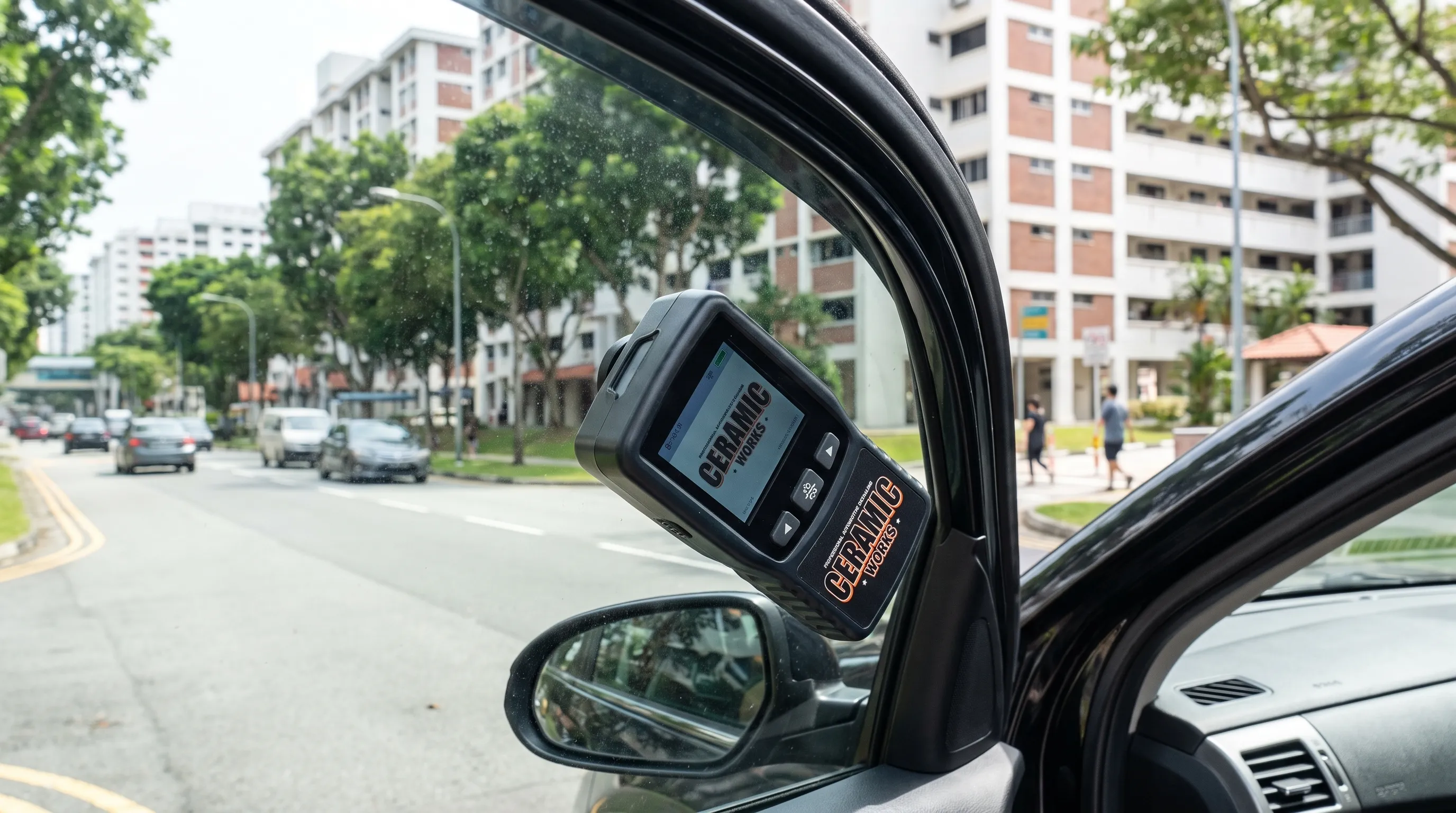
Is Solar Film for Car Windows Legal in Singapore?
Is Solar Film for Car Windows Legal in Singapore?
Yes, solar film for car windows is legal in Singapore, provided the finished windows meet the Land Transport Authority’s (LTA) light-transmission requirements and other installation conditions. The key is not simply choosing a film advertised as “LTA compliant”, but checking how it performs on your car’s existing glass. If you are considering Ceramic Works’ Solar Film service, discuss these requirements before selecting a shade.
What Makes Solar Film for Car Windows Legal?
LTA sets different minimum light-transmission levels for the front and rear windows. Its official vehicle modification guidelines explain the requirements for tinted glass and tinted films.
| Window Position | Minimum Light Transmission |
|---|---|
| Front windscreen | 70% |
| Two front side windows | 70% |
| Rear windscreen | 25% |
| Rear side windows | 25% |
These percentages describe how much visible light must pass through the window. A higher percentage means more light passes through, not a darker tint.
The limits apply to the glass and film together. A film’s standalone specification does not establish whether the completed window complies.
Other Conditions Beyond Tint Darkness
LTA also requires tinted films to be non-reflective. Film fitted to the front windscreen must not affect signal transmission between the vehicle’s ERP equipment and the ERP gantry.
Do not assume that a mirror-like finish is acceptable simply because its light-transmission figure meets the minimum. Similarly, ask about ERP compatibility rather than relying on a general claim that a film is suitable for cars.
Compliant tinted glass and films do not require prior LTA approval under the published modification guidelines. That does not remove your responsibility to ensure the actual installation meets the rules.
Why a Film’s VLT Rating Is Not Enough
When choosing solar film for car windows, visible light transmission (VLT) needs to be assessed across the complete window, including any factory tint. Even glass that looks clear can reduce the amount of light passing through it.
As a simplified illustration, suppose your existing glass transmits 80% of visible light and the proposed film transmits 70%:
Estimated combined transmission = 0.80 × 0.70 = 56%.
That is below the 70% minimum for the front windscreen and front side windows, despite the film itself having a 70% VLT rating.
The multiplication is a useful screening estimate, not a substitute for measurement. Product specifications, optical interactions and test conditions can affect the finished result. Have the installed window checked with an appropriate tint meter.
Factory Tint Can Leave Less Room for Additional Film
This matters especially when buying a used car or importing a vehicle with existing tinted glass. There may already be aftermarket film on the windows, even if the seller cannot identify it.
Ask the installer to assess the existing glass and identify any film before recommending a replacement. Layering another film over an unknown installation can reduce light transmission further.
If the glass itself is already below the applicable minimum, adding ordinary solar film will not make it compliant. The underlying glazing needs to be assessed before proceeding.
How to Check Your Car Before and After Installation
A sensible approach to solar film for car windows involves checking the starting condition, choosing suitable specifications and verifying the finished installation. A package name or shade description cannot replace those checks.
Before Installation
Ask for the proposed film’s VLT specification and an explanation of its suitability for each window position. The front and rear windows have different legal limits, so one shade may not suit every pane.
Request a check of your existing windows, particularly if they have factory tint or an unknown aftermarket layer. Discuss non-reflectivity and ERP compatibility as well.
Choosing a combination comfortably above the minimum gives more room for differences between nominal product ratings and actual readings. Selecting a film that only theoretically reaches the threshold leaves little margin.
After Installation
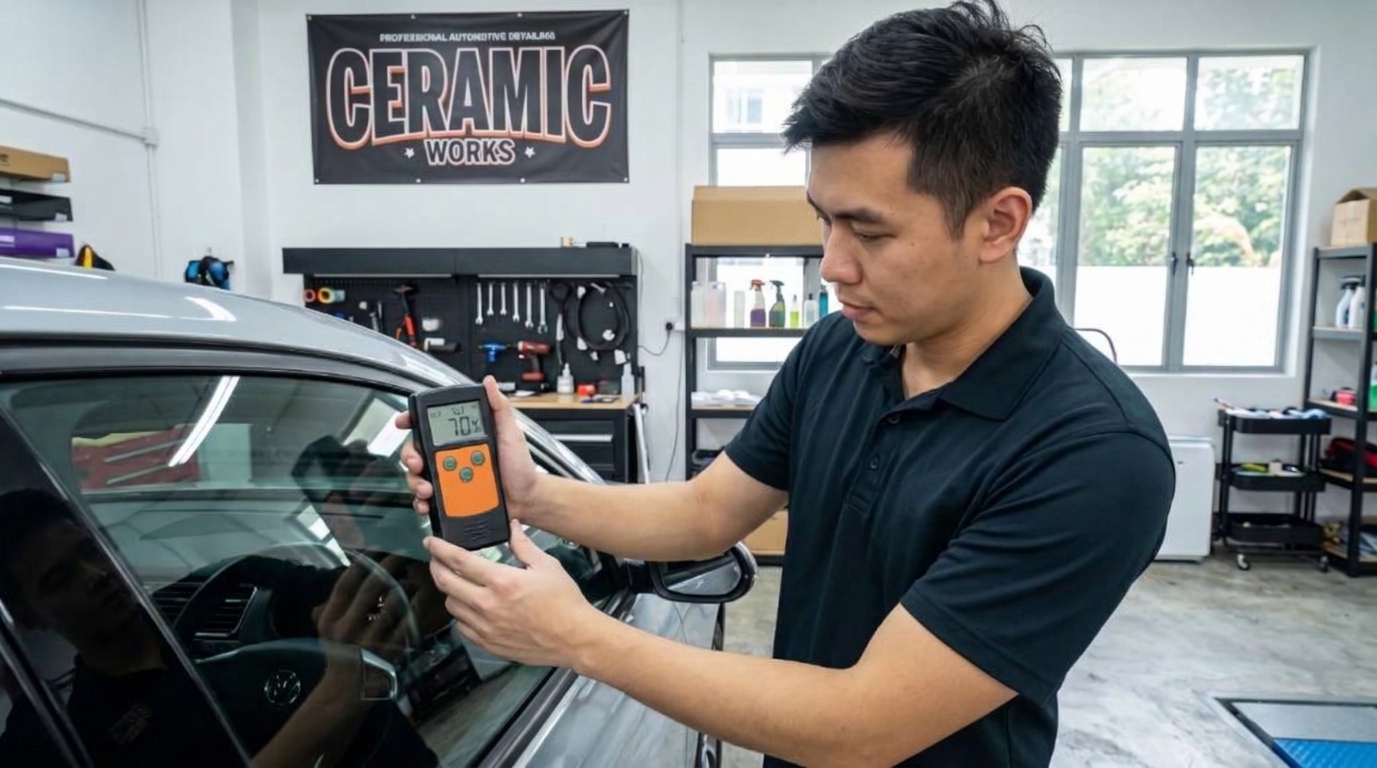
Ask for the completed windows to be measured, rather than judging compliance by appearance. Where testing is provided, request the readings for individual windows and retain them with your installation documentation.
Confirm what the installer will do if a finished window falls below the required transmission level. Resolving that question before booking is easier than discovering an issue during inspection.
Keep your invoice and film specifications, but understand their limits: paperwork can identify what was installed, while measurements establish the light transmission of the actual window.
Can Legal Window Film Still Reduce Cabin Heat?
Yes. A film does not need to look very dark to reduce solar heat entering the cabin. Visible light transmission and heat rejection describe different aspects of performance.
When comparing products, distinguish between these specifications:
VLT: The amount of visible light transmitted, which is central to Singapore’s tint limits.
Total solar energy rejection (TSER): A measure of how much overall solar energy the tested glazing system rejects.
Infrared rejection: A measure relating to infrared energy, whose stated result depends on the wavelength range and testing method.
Avoid comparing a headline infrared-rejection percentage directly with another product’s TSER figure. They are not interchangeable, and results should be compared under equivalent test conditions.
Legal solar film for car windows can offer useful heat reduction without sacrificing the visibility required at the front of the vehicle. Ask for supporting specifications rather than assuming that the darkest-looking option performs best.
Film also does not prevent a parked car from becoming dangerously hot. Never leave children or pets unattended inside a vehicle, regardless of the film fitted.
What Happens If Your Tint Is Non-Compliant?
Non-compliant tint can create problems during vehicle inspection or enforcement checks. You may need to remove or replace the film and have the windows checked again. Do not treat an installer’s assurance as a substitute for meeting LTA’s requirements.
If solar film for car windows produces a reading below the legal minimum, identify whether the problem comes from the aftermarket film, the underlying glass or both. Removing film may resolve the issue, but it will not correct factory glass that is itself too dark.
Arrange rectification promptly and consult LTA or your inspection centre if you are unsure what evidence or follow-up inspection is required. Avoid applying another layer as a quick fix, since additional film generally reduces light transmission further.
Frequently Asked Questions
Is 70% VLT Film Legal on the Front Windows?
Not automatically. The front windscreen and two front side windows must each allow at least 70% light transmission after accounting for both glass and film. A film rated at 70% can produce a lower combined reading when installed.
Can Rear Windows Be Darker Than Front Windows?
Yes. LTA’s minimum is 25% light transmission for the rear windscreen and rear side windows, compared with 70% for the front windscreen and two front side windows. The other applicable film conditions still apply.
Does an “LTA-Compliant” Label Guarantee Compliance?
No. Compliance depends on the completed installation, including the existing glass, non-reflectivity and front-windscreen ERP signal compatibility. Ask for window-specific measurements instead of relying only on packaging or a sales description.
Do I Need Approval Before Installing Compliant Film?
Under LTA’s published guidelines, prior approval is not required for tinted glass or films that satisfy its conditions. Check the current official guidance before installation, especially if your vehicle already has tint of uncertain specification.
Choose Comfort Without Compromising Compliance
Start with your car’s existing glass, not just a preferred shade. Ask Ceramic Works for a quote and discuss the proposed specifications, compatibility and post-installation checks before booking. Knowing how compliance will be verified helps you make a better-informed choice.